It Was Not Until Rule That a Distinctly Islamic Style of Art and Architecture Emerged
For many, the Muslim world in the medieval menses (900–1300) means the crusades. While this era was marked, in role, by military struggle, it is also overwhelmingly a period of peaceable exchanges of goods and ideas between West and E. Both the Christian and Islamic civilizations underwent groovy transformations and internal struggles during these years. In the Islamic world, dynasties fractured and began to develop distinctive styles of art. For the offset fourth dimension, disparate Islamic states existed at the same time. And although the Abbasid caliphate did not fully dissolve until 1258, other dynasties began to form, even before its end.
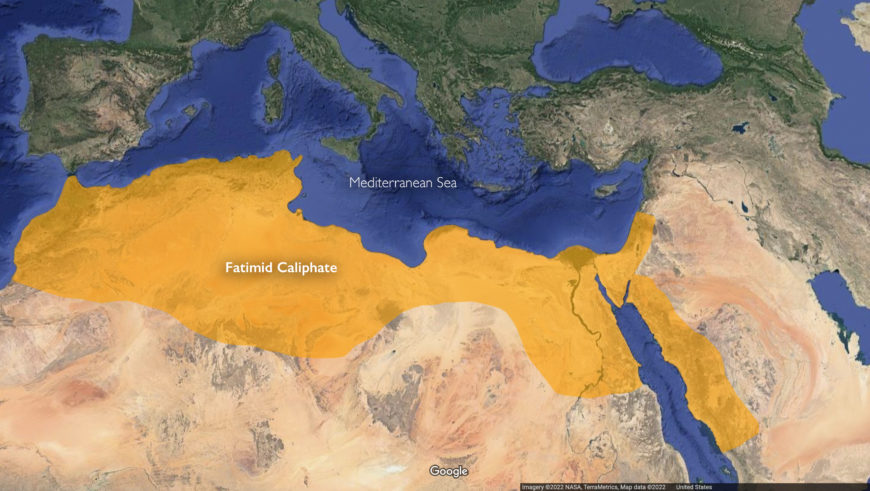
The Fatimid Caliphate at its peak, c. 969 (underlying map © Google)
Fatimid (909–1171)
In the tenth century, the Fatimid dynasty emerged and posed a threat to the rule of the Abbasids. The Fatimid rulers, function of the Shi'ia faction, took their name from Fatima, Muhammad'southward daughter, from whom they claimed to exist descended. The Sunnis, on the other hand, had previously pledged their alliance to Mu'awiya, the founder of the Umayyad dynasty. At the height of their power, the Fatimids claimed lands from nowadays-day Algeria to Syrian arab republic. They conquered Egypt in 969 and founded the city of Cairo as their capital.
The Fatimid rulers expanded the power of the caliph and emphasized the importance of palace compages. Mosques too were deputed by royalty and every aspect of their ornamentation was of the highest caliber, from expertly-carved wooden minbars (where the spiritual leader guides prayers inside the mosque) to handcrafted metal lamps.
The wealth of the Fatimid court led to a full general bourgeoning of the craft merchandise even outside of the religious context. Centers near Cairo became well known for ceramics, glass, metal, wood, and especially for lucrative fabric production. The style of decoration developed also, and artisans began to experiment with different forms of abstracted vegetal ornament and human figures.
This period is often called the Islamic renaissance, for its booming trade in decorative objects as well as the high quality of its artwork.
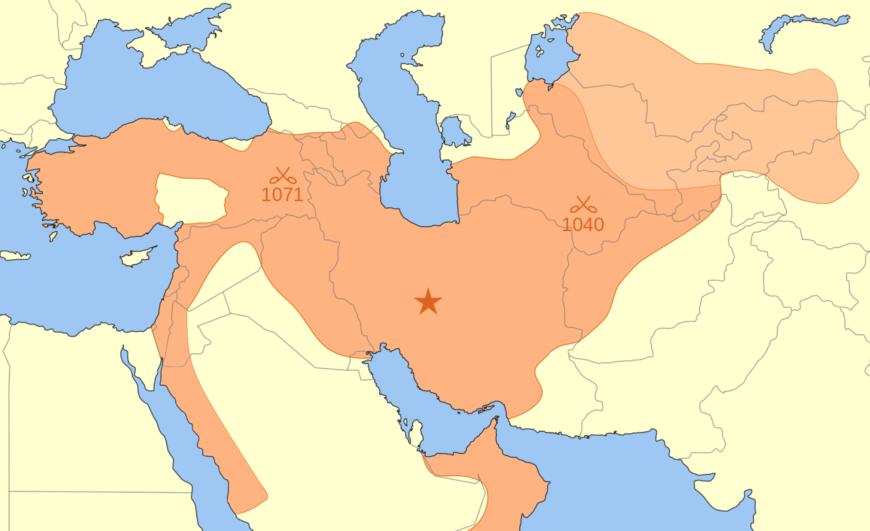
The Seljuk Empire in 1092 (photo: Osman bey, CC By-SA 4.0)
Seljuk (1040–1157/1081–1307)
The Seljuk rulers were of Cardinal Asian Turkic origin. Once they assumed power after 1040, the Seljuks introduced Islam to places it had not been heretofore. The Seljuks of Rum (referring to Rome) ruled much of Anatolia, what is now Turkey (between 1040 and 1157), while the Seljuks of present-day Islamic republic of iran controlled the rest of the empire (from 1081 to 1307).
The Seljuks of Iran were keen supporters of education and the arts and they founded a number of important madrasas (schools) during their brief reign. The congregational mosques they erected began using a iv-iwan programme: these comprise iv immense doorways (iwans) in the center of each wall of a courtyard.
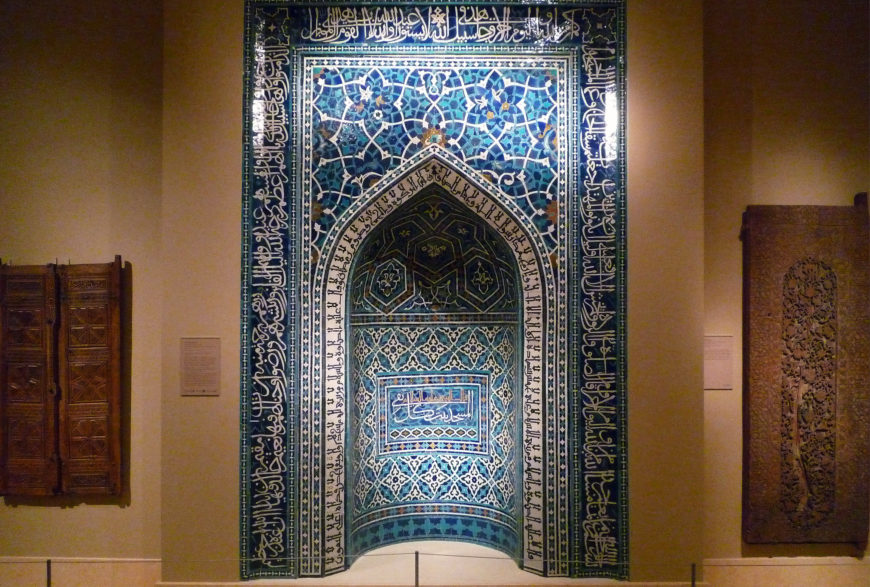
Mihrab (prayer niche), 1354–55, Madrasa Imami, Isfahan, Iran, polychrome glazed tiles, 135-ane/16 x 113-xi/sixteen inches (Metropolitan Museum of Art, New York; photograph: Steven Zucker, CC BY-NC-SA 2.0)
The art of the Anatolian Seljuks looks quite different, possibly explaining why it is oftentimes labeled as a distinct sultanate. The inhabitants of this newly conquered land in Anatolia included members of various religions (largely Buddhists and Shamen), other heritages, and the Byzantine and Armenian Christian traditions. Seljuk projects frequently drew from these existing ethnic traditions—simply as had been the case with the earliest Islamic buildings. Building materials included stone, brick, and wood, and there existed a widespread representation of animals and figures (some human) that had all but disappeared from architecture elsewhere in Islamic-ruled lands. The craftsmen here made great strides in the surface area of woodcarving, combining the elaborate scrolling and geometric forms typical of the Arabic artful with wood, a medium indigenous to Turkey (and rarer in the desert climate of the Middle E).
Mamluk (1250–1517)
The name 'Mamluk', like many names, was given past afterwards historians. The word itself means 'owned' in Arabic. It refers to the Turkic slaves who served as soldiers for the Ayyubid sultanate before revolting and rising to power. The Mamluks ruled over fundamental lands in the Eye East, including Mecca and Medina. Their upper-case letter at Cairo became the artistic and economical eye of the Islamic world at this time.
The period saw a great production of art and architecture, peculiarly those commissioned by the reigning sultans. Patronizing the arts and creating monumental structures was a way for leaders to brandish their wealth and make their power visible within the landscape of the city. The Mamluks synthetic endless mosques, madrasas and mausolea that were lavishly furnished and decorated. Mamluk decorative objects, particularly glasswork, became renowned throughout the Mediterranean. The empire benefitted from the merchandise of these goods economically and culturally, equally Mamluk craftsmen began to incorporate elements gleaned from contact with other groups. The growing prevalence of merchandise with Communist china and exposure to Chinese goods, for instance, led to the Mamluk product of blueish and white ceramics, an faux of porcelain typical of the Far East.
The Mamluk sultanate was generally prosperous, in part supported past pilgrims to Mecca and Medina as well as a flourishing textile market place, simply in 1517 the Mamluk sultanate was overtaken and absorbed into the growing Ottoman empire.
Boosted resources
The Fine art of the Fatimid Period (909–1171) from The Metropolitan Museum of Art's Timeline of Art History
The Art of the Seljuqs of Islamic republic of iran (ca. 1040–1157)
The Art of the Mamluk Period (1250–1517)
Mosque Lamp from the Brooklyn Museum
Source: https://smarthistory.org/arts-of-the-islamic-world-the-medieval-period/
0 Response to "It Was Not Until Rule That a Distinctly Islamic Style of Art and Architecture Emerged"
Post a Comment